

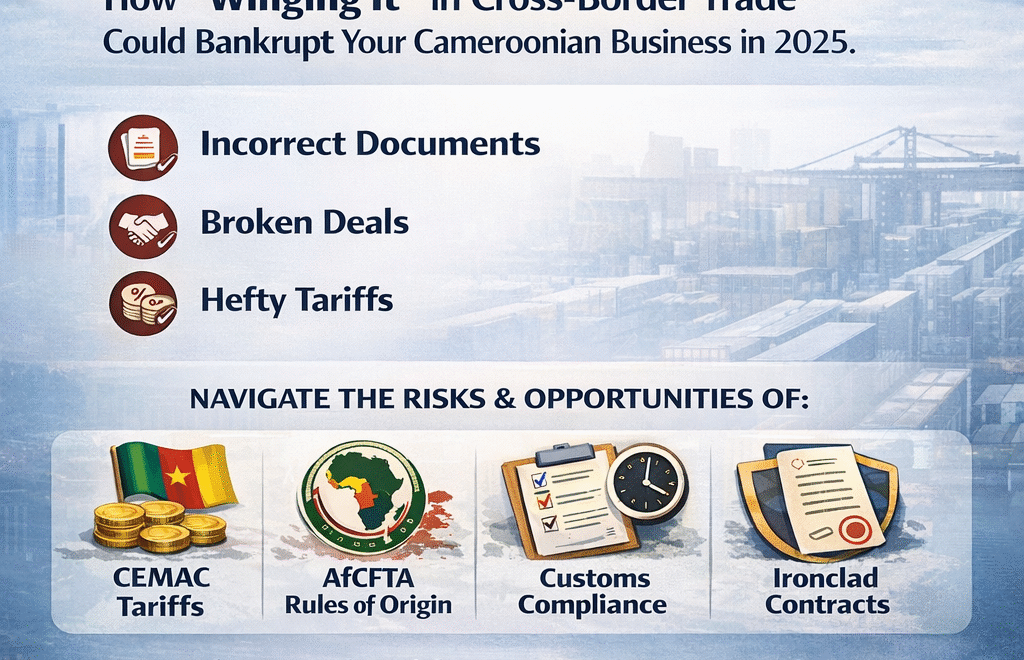
Introduction: The New Horizon of African Trade
For Cameroonian businesses, the landscape of cross-border commerce is undergoing a profound transformation. The dual forces of deepening regional integration within the Central African Economic and Monetary Community (CEMAC) and the historic launch of the African Continental Free Trade Area (AfCFTA) have converged to create an era of unprecedented opportunity. Cameroonian enterprises now stand at the gateway to a continental market encompassing over 1.3 billion people and a combined gross domestic product (GDP) exceeding USD 3.4 trillion.
However, this access is not unconditional. It is predicated on navigating a complex web of legal frameworks, from harmonized regional regulations to nascent continental protocols. This guide serves as a comprehensive legal roadmap, providing Cameroonian businesses with the essential knowledge to not only comply with these multifaceted requirements but to strategically leverage them for sustainable, cross-border growth in 2025 and beyond.
Part I: The Foundational Pillars – Cameroon’s Multilateral Trade Frameworks
Cameroon’s trade policy is defined by its membership in two critical, overlapping trade blocs: the CEMAC and the AfCFTA. Understanding the distinct yet complementary nature of these frameworks is the first step toward effective market entry.
1. The CEMAC Imperative: Consolidating Regional Integration
The Central African Economic and Monetary Community (CEMAC)—comprising Cameroon, the Central African Republic, Chad, the Republic of Congo, Equatorial Guinea, and Gabon—is more than a free trade area; it is a customs and monetary union. This deep integration, underpinned by a common currency (the CFA franc), establishes a unique legal and commercial environment.
– The Common External Tariff (CET): The CET is the cornerstone of the CEMAC customs union. It mandates a uniform tariff on goods imported from non-member states, protecting the regional market while fostering internal competitiveness. For Cameroonian businesses, mastering the Harmonized System (HS) codes for accurate tariff classification is paramount, as it determines applicable duties and informs sourcing and pricing strategies.
– Intra-CEMAC Trade Preferences: Goods originating within the CEMAC zone benefit from significant advantages, including reduced or eliminated tariffs and streamlined customs procedures. To leverage these preferences, businesses must master the rules of origin and obtain the requisite Certificates of Origin from authorized bodies, such as the Cameroon National Shippers’ Council (CNSC) or local Chambers of Commerce.
– Regulatory Harmonization: Beyond tariffs, CEMAC is progressively harmonizing technical regulations, sanitary and phytosanitary (SPS) measures, and product standards. Compliance with these regional norms—from quality certifications to conformity assessments—is non-negotiable for accessing the community market and ensures a level playing field focused on consumer safety and product quality.
2. The AfCFTA Frontier: Unlocking Continental Scale
The AfCFTA represents a paradigm shift, aiming to create a single continental market for goods and services. For Cameroonian exporters, it offers access to 54 African nations, but this access is contingent upon strict compliance with its foundational protocols.
– Rules of Origin: The Passport to Preference: The AfCFTA’s rules of origin are the most critical compliance element. They determine which goods are “originating” and therefore eligible for preferential tariff treatment. These rules are based on criteria such as substantial transformation, value addition (often a regional value content threshold), or a change in tariff classification. Businesses must meticulously document their production processes to prove origin and secure the necessary AfCFTA Certificates of Origin.
– Navigating Tariff Liberalization Schedules: The AfCFTA’s benefits are not instantaneous. Tariff liberalization is phased, with schedules varying by product category and country classification (e.g., non-LDCs vs. LDCs). Understanding these schedules—whether a product falls under the “non-liberalized” (excluded) list or is subject to a 5-, 10-, or 15-year tariff phase-out—is crucial for strategic market timing, pricing, and investment planning.
– Trade in Services: The AfCFTA Protocol on Trade in Services opens doors for Cameroonian service providers in sectors like finance, transport, telecommunications, and professional services. However, market access is often subject to domestic regulations, licensing requirements, and the mutual recognition of professional qualifications. A targeted strategy is required to navigate these sector-specific legal landscapes in each destination country.
Part II: The Mechanics of Compliance – Customs, Contracts, and Finance
With a firm grasp of the macro-level frameworks, businesses must turn to the granular mechanics of daily cross-border operations.
1. Mastery of Customs Procedures and Documentation
Efficient and compliant cross-border trade hinges on meticulous documentation and a thorough understanding of customs law.
– Essential Import/Export Documentation: Key documents include the Pro Forma and Commercial Invoice, Packing List, Bill of Lading/Air Waybill, Certificate of Origin, and any product-specific permits (e.g., phytosanitary certificates for agricultural goods, health certificates for food products). Accuracy and completeness are paramount to avoid costly delays, demurrage charges, and potential seizures.
– Customs Valuation: Cameroon Customs adheres to the WTO Valuation Agreement, primarily using the “transaction value” method. This requires accurate and transparent pricing between buyer and seller. For related-party transactions, rigorous transfer pricing documentation is essential to justify declared values and prevent disputes with customs authorities.
– Leveraging Customs Brokers: Engaging a reputable, licensed customs broker is not an option but a necessity. They act as indispensable partners, ensuring compliance with ever-changing regulations, calculating correct duties, and managing clearance processes efficiently.
2. The Law of the Deal: Structuring International Commercial Contracts
A well-drafted contract is the bedrock of any successful international transaction, mitigating risk and clarifying obligations.
– Incoterms® as the Lingua Franca:International Commercial Terms (Incoterms), published by the International Chamber of Commerce (ICC), must be incorporated into every sales contract. They definitively allocate delivery obligations, risk transfer points, and costs (including transport and insurance) between buyer and seller, preventing costly misunderstandings.
– Securing Payment and Trade Finance: The choice of payment method is a critical risk allocation decision. Options range from secure but complex Letters of Credit (L/Cs) to cost-effective documentary collections for established relationships and open account terms for the highest level of trust. Each method has distinct legal and procedural implications that must be clearly defined in the contract.
– Dispute Resolution Clauses: International contracts must specify a robust dispute resolution mechanism. Given the complexities of litigating in foreign national courts, businesses are strongly advised to include an arbitration clause. Referring disputes to a neutral institution like the ICC International Court of Arbitration® or the OHADA Common Court of Justice and Arbitration provides a predictable, enforceable, and specialized forum for resolution.
3. Fiscal and Financial Navigation
– Strategic Customs Duty Optimization: Beyond mere payment, proactive duty management can yield significant savings. This includes verifying correct HS classifications, utilizing preferential origin (CEMAC/AfCFTA), employing customs warehousing regimes to defer duty payments, and claiming duty drawback on re-exported goods.
– Cross-Border VAT Treatment: The VAT treatment of exports (typically zero-rated) and imports (liable to VAT at the point of entry) is a critical cash flow consideration. Businesses must understand the procedures for claiming input VAT credits on goods and services used for export activities and ensure compliance with reporting requirements in both Cameroon and the destination country.
– BEAC Foreign Exchange Regulations:The Bank of Central African States (BEAC) strictly regulates all foreign exchange transactions. Cameroonian businesses must route all international payments through authorized intermediary banks, provide full supporting documentation (e.g., the validated import dossier – Déclaration Unique des Marchandises (DUM) ), and adhere to strict timelines for the repatriation of export proceeds.
Part III: Sector-Specific and Operational Realities
The practical application of these legal principles varies significantly across industries.
– For Agricultural Exporters: Compliance is dominated by SPS requirements. This involves rigorous traceability, adherence to maximum residue limits (MRLs) for pesticides, and obtaining official health and phytosanitary certificates recognized by the destination country’s competent authority.
– For Manufacturers and Industrial Goods Exporters:The focus is on technical regulations and conformity assessment. Products may need to meet specific standards (e.g., those set by the Agence des Normes et de la Qualité – ANOR) and undergo testing and certification procedures mandated by the importing country.
– For Technology and Digital Service Providers: The legal frontier involves navigating data localization laws, consumer protection statutes, and intellectual property rights enforcement in multiple jurisdictions, as well as the evolving regulatory landscape for cross-border data flows under the AfCFTA.
Part IV: Strategic Implementation and Risk Mitigation
Success in cross-border trade is not accidental; it is the product of deliberate strategy and robust risk management.
– Holistic Risk Management: A comprehensive approach must address political and country risk (through tools like political risk insurance), commercial risk (via credit insurance and due diligence on partners), and regulatory risk (through proactive compliance programs and trade law expertise).
– Building a Trade Compliance Culture: Businesses should institutionalize compliance by developing internal trade manuals, conducting regular staff training, and implementing systems for denied-party screening, export control classification, and record-keeping. This proactive culture is the best defense against inadvertent violations and regulatory penalties.
– Orchestrating Professional Support:No business can navigate this complexity alone. Success requires a coordinated team of specialized professionals: international trade legal counsel for strategic guidance and contract drafting, customs brokers for operational clearance, freight forwarders for logistics, and trade finance specialists at banks for secure payments.
Conclusion: From Compliance to Competitive Advantage
For Cameroonian businesses, the path to successful cross-border trade in the CEMAC and AfCFTA era is paved with legal complexity. However, this guide has demonstrated that compliance is not merely a defensive necessity; it is a strategic asset. A sophisticated understanding of tariff regimes, rules of origin, customs procedures, and commercial law empowers businesses to optimize costs, mitigate risks, and access new markets with confidence.
By embracing a culture of legal diligence and engaging expert partners, Cameroonian enterprises can transform the challenges of regulatory compliance into a durable competitive advantage, positioning themselves at the forefront of Africa’s historic economic integration.
—For specialized legal counsel on structuring your cross-border trade operations, navigating complex compliance matters, or resolving international trade disputes, the team at Fonyam and Partners is uniquely positioned to provide comprehensive, solution-oriented guidance