

By Banyong Fonyam Jonie Jr.
Managing Partner, Fonyam & Partners Law Firm, Douala
Legal & Regulatory Compliance Professional — CEMAC Region
Introduction
On 7 October 2026, the Ministerial Committee of the Central African Monetary Union (UMAC) convened in ordinary session in N’Djamena, Republic of Chad, under the chairmanship of Tahir Hamid Nguilin, Minister of State, Minister of Finance, Budget, Economy, Planning and International Cooperation of the Republic of Chad. Among the decisions adopted was the Regulation amending Articles 88, 89, 90, and 91 of Regulation No. 01/22/CEMAC/UMAC/CM/COSUMAF of 21 July 2022 on the organisation and functioning of the Central African financial market.
This reform, led by the Financial Markets Supervisory Authority of Central Africa (COSUMAF), introduces substantial and unambiguous changes to the private placement regime — a capital-raising mechanism reserved for qualified investors and operating by way of derogation from the public offering regime. The express objective is to facilitate financing for the real economy, particularly in infrastructure, energy, industry, and agribusiness, while maintaining the supervisory safeguards that justify this special regime.
The reform follows a public consultation conducted from 7 to 16 July 2026, during which stakeholders raised concerns about ambiguities in the draft text. The final adopted version resolves these ambiguities and delivers clear, impactful modifications.
1. Key Amendments to Private Placement Conditions
The new amending regulation modifies eight articles across four provisions, with the following principal changes:
1.1 Widening the Investor Base
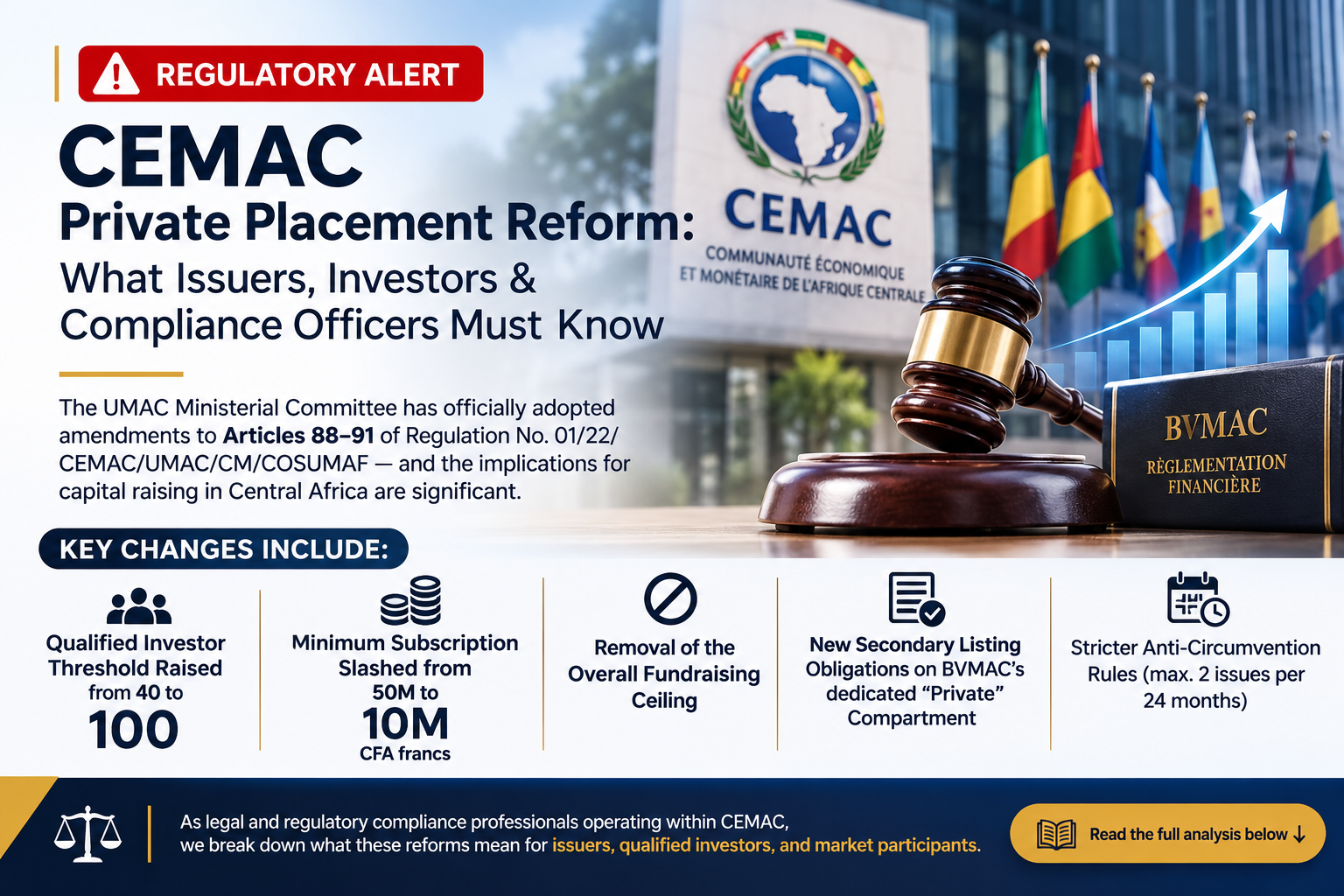
The maximum number of qualified investors permitted in a private placement has been increased from 40 to 100. This expansion allows issuers to distribute securities among a broader pool of subscribers, reducing dependence on a small number of investors while preserving the selective character of the private placement.
1.2 Reduction of Minimum Subscription
The minimum subscription per investor has been definitively set at 10,000,000 CFA francs, down from 50,000,000 CFA francs under the previous regime. The final text removes the inconsistency present in the July 2026 draft (which contained a discrepancy between the amount in words and figures) and provides legal certainty on this threshold. This reduction enables finer distribution of subscriptions among qualified investors.
1.3 Abolition of the Overall Fundraising Ceiling
The new text introduces a clear provision stating that “private placement transactions are not subject to any limit on the amount.” This eliminates the previous 20 billion CFA francs ceiling over twelve months, offering unprecedented flexibility for large-scale structuring projects.
2. Reform of the Qualified Investor Concept
The new regulation structures the distinction between investors qualifying by operation of law and those requiring authorisation:
2.1 Investors by Operation of Law (Article 89)
The following entities are automatically recognised as qualified investors:
• Credit institutions
• Collective investment undertakings and their management companies
• Insurance and reinsurance companies
• Mutual societies and provident institutions
• Pension funds
• Development finance organisations
• Brokerage firms
• Investment funds
• Regional financial institutions
2.2 Investors on Request (Article 89-1)
Natural and legal persons not automatically qualified may now apply to COSUMAF for qualified investor status, subject to demonstrating:
• Adequate skills and means to understand the risks of financial instrument transactions
• Net worth of at least 50 million CFA francs (for natural persons)
• Equity of at least 250 million CFA francs (for legal persons)
COSUMAF maintains and publishes an updated list of qualified investors on its website, ensuring transparency and regulatory certainty. (Note: Practitioners may legitimately request clarification on the types of documents admissible as evidence of net worth.)
3. New Rules on Liquidity and Frequency
3.1 Secondary Listing Obligation (Article 91-1)
The resale of securities created through private placement is now strictly regulated. Such securities may only be sold between qualified investors and must be traded on a dedicated compartment of the Central African Securities Exchange (BVMAC) — specifically, Compartment D, designated as the “Private” Sub-Fund (or Private Equity Sub-Fund). This addresses the liquidity concerns inherent in the closed character of private placements while maintaining regulatory oversight of secondary market activity.
3.2 Cap on Issuances (Article 91-2)
To prevent circumvention of the public offering regime, an issuer is now limited to a maximum of two private placement issues over a rolling period of 24 months.
3.3 Clarification of COSUMAF’s Role (Article 90)
Registration with COSUMAF constitutes a formal check of compliance of the file and does not entail approval of the economic and financial conditions of the transaction, which remain the exclusive responsibility of the issuer and investors. This clarification reinforces the principle that private placement operates on the basis of investor sophistication rather than regulatory merit review.
4. Opening to Non-Resident Issuers
Article 91 permits external issuers not established in CEMAC to carry out private placements, subject to:
• Compliance with financial market regulations
• Compliance with foreign exchange regulations in force
An accelerated procedure is available for issuers bound by cooperation agreements with the Bank of Central African States (BEAC) or COSUMAF. This provision maintains the link between access to regional financing and compliance with monetary requirements.
5. Transitional Provisions (Article 3)
For legal certainty, private placement transactions registered before the entry into force of the new regulation remain governed by the old provisions until their completion.
6. What the Reform Does Not Address
The reform document does not expressly provide for:
• Integration of digital tokens into the private placement regime
• Creation of a crowdfunding regime
• A new dematerialised registration procedure
However, these prospects should not be excluded from future regulatory developments, as the reform essentially reiterates the definition of qualified investors, the registration obligation, and the rules applicable to non-resident issuers.
Conclusion
The UMAC reform represents a controlled relaxation rather than deregulation. It seeks to increase financing opportunities for the real economy without erasing the criteria that distinguish a private placement from a public offering. The reservation of the offer to qualified investors, the restriction of sales to the selected circle, subscription on own account (with exceptions for certain management companies), registration with COSUMAF, and compliance with foreign exchange regulations for non-resident issuers all remain intact.
For issuers, investors, and compliance professionals operating within the CEMAC region, understanding these amendments is essential for effective capital-raising strategies and regulatory compliance.
About the Author
Banyong Fonyam Jonie Jr. is the Managing Partner of Fonyam & Partners Law Firm in Douala, Cameroon. He is a seasoned legal and regulatory compliance professional with extensive experience in financial markets, corporate law, and regulatory affairs across the CEMAC region.