

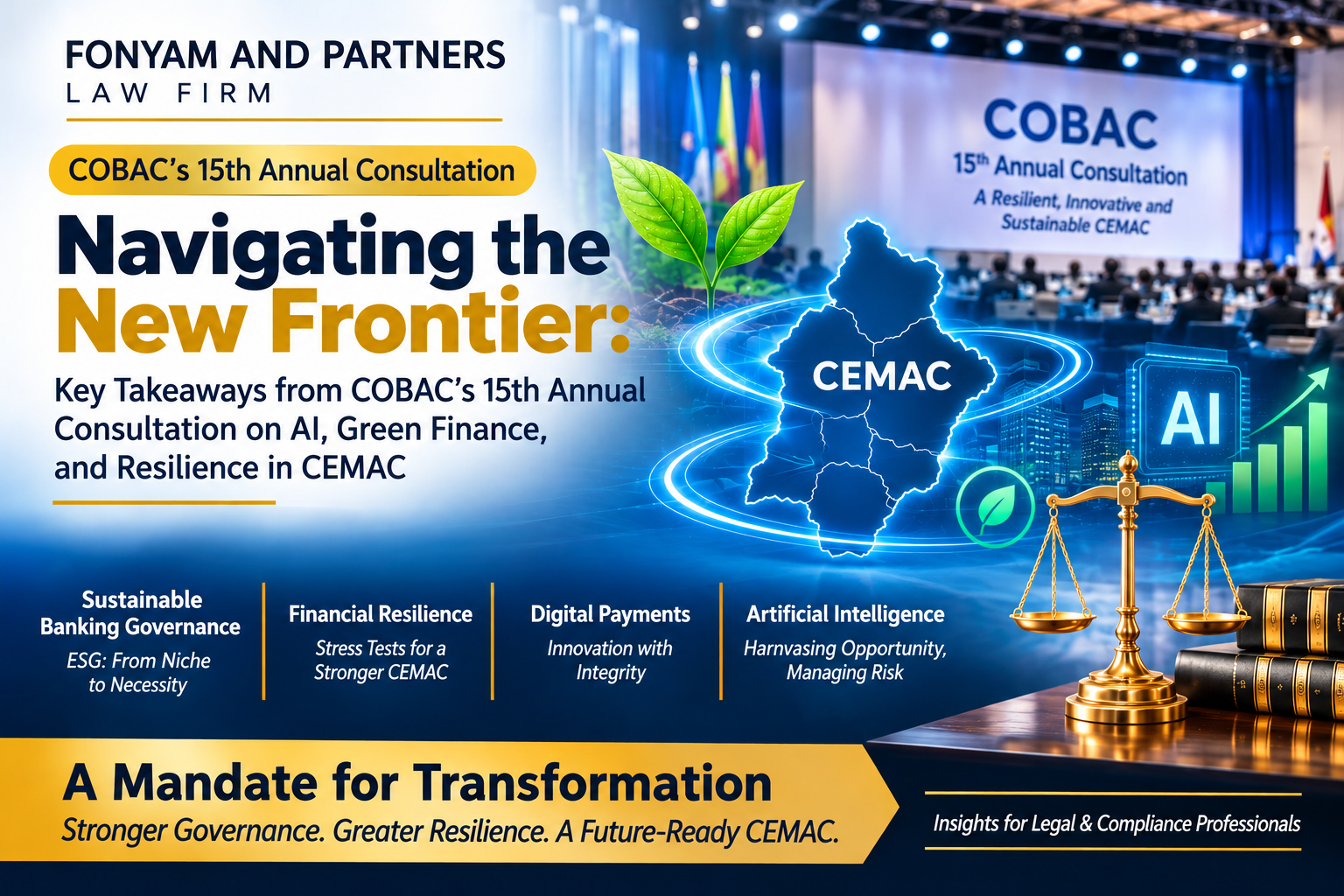
The 15th Annual Consultation Meeting of the President of the Central African Banking Commission (COBAC) with the banking and financial profession, held on September 25, 2026, in Malabo, was more than a routine regulatory briefing. It was a strategic roadmap for the future of finance in the Central African Economic and Monetary Community (CEMAC). Chaired by the Governor of the Bank of Central African States (BEAC), Mr. Yvon Sana Bangui, the meeting crystallised the pressing need for the region’s financial institutions to evolve from a state of general stability to one of proactive, future-proofed resilience.
For legal and compliance professionals, the discussions, structured around four strategic axes, signal a significant shift in supervisory expectations. The message from the regulator is unambiguous: the institutions of tomorrow must be governed by the principles of sustainability, fortified by advanced risk management, and built upon a foundation of technological integrity and robust AML/CFT controls.
1. Banking Governance in the Era of Sustainable Finance: From Niche to Necessity
Mr. Félix Ndzie’s presentation on Environmental, Social, and Governance (ESG) risks was a clarion call. ESG is no longer a peripheral concern; it is a material financial risk that can impact asset values, creditworthiness, and institutional reputation. The key takeaways for the CEMAC banking sector are clear:
• A Community-Wide Strategy: A fragmented approach to ESG is insufficient. A harmonised community strategy, underpinned by a green taxonomy tailored to our unique economic and social context, is essential.
• Boardroom Accountability: The responsibility for managing ESG risks rests squarely with the corporate bodies. It demands a redefinition of their role and a proactive stance in identifying, assessing, and mitigating these risks.
• Capacity Building: Supervisors and institutions alike must invest in building the expertise required to navigate this complex landscape. The forthcoming reforms, particularly the Single Banking Law, will provide the legal bedrock for this evolution, but the human capital must be cultivated in parallel.
2. Stress Tests and Financial Resilience: A Tool for Strategic Vision
Mr. Justin Bem’s update on stress testing moved the conversation from a compliance exercise to a strategic imperative. Stress tests are no longer mere regulatory hurdles; they are indispensable tools for strategic management, allowing institutions to identify vulnerabilities and fortify their defencesagainst plausible adverse scenarios. The regulator’s call for greater involvement from the banks’ governing bodies is a critical development. It underscores that resilience is not just a technical function but a core element of corporate strategy, demanding the active engagement of the board and senior management.
3. The Digital Payments Revolution: Balancing Innovation with Integrity
The exponential growth of mobile payments, as highlighted by Mr. William Nlembe of Orange Money Cameroon, represents a monumental opportunity for financial inclusion. However, with great opportunity comes significant risk. The surge in digital transactions has amplified the threats of fraud, cybercrime, and non-compliance with Anti-Money Laundering and Combating the Financing of Terrorism (AML/CFT) standards. The call to strengthen control and traceability mechanisms is a direct warning to all payment service providers. For compliance officers, this means a continuous investment in advanced monitoring systems, robust customer due diligence (CDD) processes, and a proactive partnership with regulators to secure the digital financial ecosystem.
4. Artificial Intelligence in Banking: The Promise and the Peril
The panel on Artificial Intelligence (AI) was arguably the most forward-looking session. Experts from the ACPR, CYBERIX, and AFG Bank Gabon painted a balanced picture of AI’s transformative potential and its attendant risks.
• Opportunities: AI offers immense capabilities in data analysis, risk assessment, regulatory compliance, and enhancing customer experience.
• Risks: The dangers of opaque algorithms (the “black box” problem), decision-making bias, data leakage, and vulnerability to cyber-attacks are real and significant.
The consensus was a resounding call for a regional AI strategy at the CEMAC level. This strategy must prioritise:
• Data Sovereignty: Developing locally hosted solutions to ensure the security and sovereignty of strategic data.
• Rigorous Supervision: Moving towards an appropriate regulatory framework that ensures the responsible, transparent, and secure use of AI.
• Skilled Professionals: Investing in training and support for institutions to manage and supervise these powerful technologies.
Conclusion: A Mandate for Transformation
The 15th Annual Consultation concluded with a powerful directive from President Sana Bangui: the imperative for institutions to strengthen their governance, resilience, and overall risk management systems. This is not an optional extra; it is a mandatory requirement to support the technological and ecological transformations underway.
As we look toward the creation of the Central African Economic and Financial Forum (FEFAC), the role of the legal and compliance professional has never been more critical. We are tasked with translating these high-level strategic directives into actionable policies and robust frameworks. The stability of our regional financial system depends on our collective ability to embrace this new era of banking with rigour, foresight, and unwavering integrity. The dialogue has been opened; now, the critical work of implementation begins.